Our planting plan

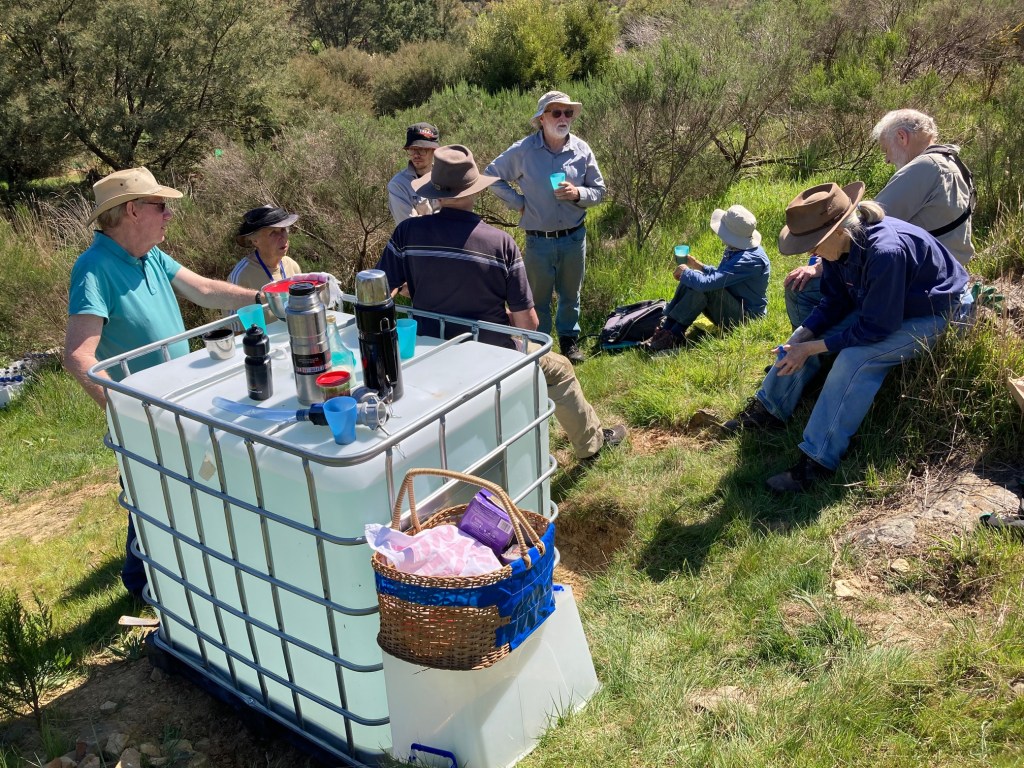
We aim to put in over 1000 plants (mainly grasses and ground-covers) over the next 10 weeks.

We start on 27 July at the Indigenous Food and Fibre (IFF) area, and then continue there and other places in August (10 & 24) and September (7 and 21) and finally October 12.

The plant numbers will vary across our sites and we hope to make our planting days enjoyable by having achievable targets for each site. We may need to dig holes for some of the sites.

You may have noticed that our first planting is on National Tree Day (July 27) but we are not heading to a big community event this year. Our largest planting will be on 24 August so if you cannot come any other time, that would be the one to join. But we would love to see you all, and see you often!

Annual General Meeting (AGM)

The Annual General Meeting (AGM) of Castlemaine Landcare Group Inc (CLG) was held at 7.30 pm on Thursday 8 May 2025. The speaker (Graham Stockfeld from Turtles Australia) was great and he brought some friends with him.

We did the normal business matters and elected the following committee:
President – Christine Kilmartin
Treasurer – Elizabeth Eager
Secretary – Gerry Egan
Committee members – Rosemary Hooke and Malcolm Robins.
We thanked Jack Piper for his stint on the committee, and noted that he was unable to renominate due to pressure of other commitments.

We would like some more committee members – if you are interested please email or ring Christine on 0418 325 350.

Forest Creek Revitalisation Project Grant

The recently received grant for the Forest Creek Revitalisation Project—Castlemaine under the Australian Government’s Urban Rivers and Catchments Program will be a major focus for 2025.  It will enable the partners [North Central Catchment Management Authority (NCCMA),  Mount Alexander Shire Council (MASC), Department of Energy, Environment and Climate Action (DEECA), DJAARA, Friends of Campbells Creek (FoCC)  and Castlemaine Landcare Group (CLG)] to work together over the next 3 years to deliver a more natural stream and streamside within the channelised section of Forest Creek and additional upstream and downstream benefits to habitat and biodiversity.  NCCMA will manage this grant.

Under that grant, we will spread the CLG work from 2025-27 at –

  • The Wilding Site behind Best Motors, between Patterson Bridge and Ten Foot Bridge, to enhance vegetation, improve access to viewing areas of the creek and monitor water quality and wildlife including aquatic species;
  • The Indigenous Food and Fibre (IFF) site, expanding its upstream and downstream riparian treatments, creating a series of ponds and riparian areas to provide refugia for wildlife including Bibron’s toadlet and expanding informal walking and viewing along the creek;
  • The lower section of the Montgomery Street grasslands, to reintroduce some threatened and rare species (note that we also anticipate a cultural burn by DEECA / DJAARA to the upper grasslands where there is kangaroo grass (Themeda triandra) but this is not part of the grant);
  • The footbridge waterhole and surrounds, to increase aquatic habitat and species and provide a viewing path and additional planting to the currently hidden anticlinal fold area; and
  • The junction of Moonlight and Forest Creeks, in the Copses area, to improve native grassland habitat.

FoCC will also be doing considerable work downstream, especially to reintroduce threatened species and protect platypus.
More of that as we go, but also will assume “weeding” is still part of the task, although it will be shared with contractors.

For 2025, we will also –

  • Continue our work on the existing section of the IFF site, with a small planting – mainly grasses;
  • Follow up, via a small planting by volunteers, on work to be carried out by DEECA along Moonlight Creek that will enhance an existing waterhole and place some tree trunks and limbs to slow water before it reaches the washaway; and
  • Set up some citizen science opportunities for our volunteers.

2024 AGM

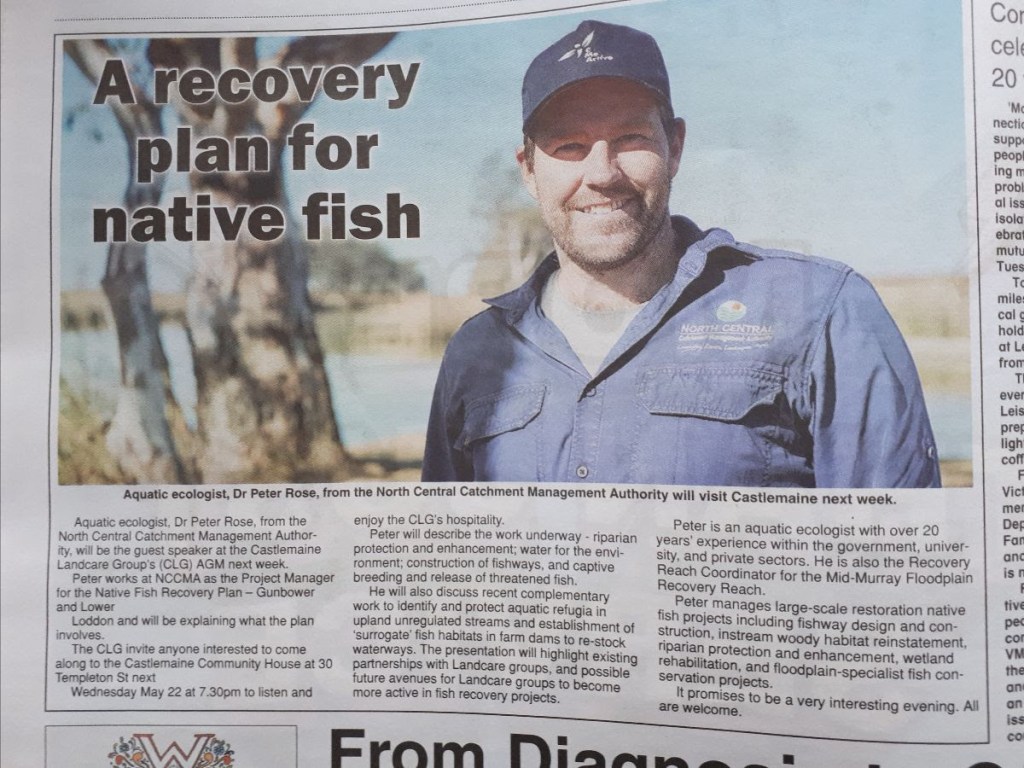
We had a very successful AGM at Castlemaine Community Centre. The feature speaker was Dr Peter Rose from the North Central Catchment Management Authority talking about actions underway to preserve and promote native fish in waterways.
The committee was elected, being the same members as last year, except for the retirement of John MacIntyre (who will however continue to do our website and social media – thanks John). The ‘winners’ are Christine Kilmartin (President), Gerry Egan (Secretary), Elizabeth Eager (Treasurer), and committee members Malcolm Robins, Rosemary Hooke and Jack Piper. There is still space on the committee if you are interested in helping out in that way.

Needle Grasses

There are three species of Needle Grass, Nassella spp., along with EspartilloAmelichloa caudata, found in the Castlemaine area.  All are highly invasive and should be reported to the relevant authorities.  Chilean Needle Grass, N. neesiana is a declared noxious weed and classed as a restricted weed across Victoria.  Volunteers from the Castlemaine Field Naturalists Club have been working to eradicate these weeds from the Castlemaine Botanic Gardens and along streets throughout the town.  This poster provides information about needle grasses in general and you can find more specific information about Chilean Needle Grass in this brochure or from Agriculture Victoria.

This information has been reposted from https://castlemainefieldnaturalists.org.au/important-weeds/

Chilean Needle Grass, Nassella neesiana. Photo: Euan Moore

Victorian Landcare Grant

We are very pleased that we have been successful in obtaining a Victorian Landcare Grant to continue work along Moonlight Creek. The project is called “Linked by Moonlight Stage 2: ‘twixt La Niña and El Niño”, indicating some of the challenges we expect to face.
The project aims to build on the outcomes of work done, and weather experienced, during 2022, to

  • repair flood damage to 2022 plantings through removal of new weeds, additional soil preparation and further infill planting
  • continue to reduce Phalaris aquatica across the site to open up more areas for natural recruitment and new plantings, including increased spread of native grasses to provide protection for kangaroos from Phalaris Staggers
  • build habitat, especially for phascogales, sugar gliders, woodland and grassland birds and pollinators
  • work together with neighbouring private landholders to reduce weed competition and expand complementary habitat
  • develop options for future reparation of streambank erosion arising from 2022 floods • consult with DEECA, NCCMA, MASC, Djaara and other partners regarding additional natural upstream works to reduce ongoing flood damage and retain water in the landscape
  • keep contact with the wider neighbourhood by letterboxing an update on our 2022 work and providing a further invitation to help improve the area
  • continue to provide an annual planting opportunity in conjunction with The Good Op Shop to the students of Castlemaine Secondary College
  • Maintain a focus on building a biolink from the Castlemaine Diggings National Heritage Park to Forest Creek through this investment.
    The grant has been obtained through the North Central Catchment Management Authority (NCCMA).
    This will keep us very busy for the next 9 months or so.

Forest Creek Revitalisation Project—Progress Report June 2023

For your information, below is an update on the Forest Creek Revitalisation Project. It has been prepared by the Implementation Group managing the progress of the project initiated by Castlemaine Landcare Group. 
The Implementation Group has representatives from Mount Alexander Shire, Dja Dja Wurrung (trading as Djaara), the Department of Energy, Environment and Climate Action and North Central Catchment Management Authority as well as from Friends of Campbells Creek and of course, Castlemaine Landcare Group, whose members coordinate the work of the Implementation Group.

Thank you for your continued interest in the Forest Creek Revitalisation Project. This promised update has been somewhat delayed as we paused to take into consideration the full impact of the October 2022 floods and the ramifications for the design of the project. We’re pleased to advise that the plans to advance the project are now back on track.
Since our public consultations finished in June, 2022, we have been busy with our consultants, Alluvium, collating your feedback and using it to draft a concept design of what might be achievable in the creek as part of the revitalisation works.During the public consultations, the online survey asked seven questions, with a combination of closed and open-ended questions. The survey sought to understand the types of visitors to Forest Creek, their sense of connection to the site, why they visited, how they used the area, and priorities for project outcomes.

There was a good response to an engagement activity of this nature, with:
115 responses to the online survey
5 responses on the interactive map
8 emailed responses.

Overall, there was very strong endorsement for the general plan to improve creek health and biodiversity, along with additional values such as improved accessibility and recognition of cultural heritage, both First Nations and post-settlement.

Through the consultations support was indicated for:

  • maintaining and enhancing the heritage walls
  • creation of a more natural stream form and habitat within the walls
  • improved recreation and amenity opportunities alongside the creek
  • maintenance of flood carrying capacity and ensuring there is no increased flood risk
  • no increased fire risk.

In general design terms there was feedback to:

  • create a more natural, winding, low-flow channel to encourage a contained, visible flow path
  • form a series of deep pools
  • create small rock riffles to provide aeration of water and pools in higher flow areas to encourage a more dynamic environment
  • remove large sections, but not all, of existing reeds
  • plant grasses and zones of native, aquatic plants (macrophytes) that will serve as a cover and food source for fish, frogs and (hopefully) platypus
  • include habitat features such as logs and rocks (subject to the ability to fix such features in place)
  • ensure that the works do not worsen any flooding.

This feedback has now been incorporated into the draft landscape design.
Our project partner, Dja Dja Wurrung, convened a Kapa Gatjin group of Djaara Elders and Traditional Owner representatives to provide input into the project, including the design phase. Kapa Gatjin (to know water) provides a Traditional Owner cultural perspective to water related matters and included undertaking an Aboriginal Waterway Assessment.

In turn, the concept drawing has been used by Alluvium to draw up a scoping report, outlining the practicalities of what needs to be done next and the formal approvals that are required to bring the project to full implementation on the ground.

To advance the project, the Forest Creek Revitalisation Implementation Group accepted the recommendation of the consultants to engage a surveyor to probe the natural surface of the creek to establish the depth of the bedrock (either natural or manmade) at various intervals in the creek and to understand the depth and nature of the sediment in the creek. That survey work is now in progress and is being developed with further input from Kapa Gatjin.

To make the concept drawings stand up more in the “mind’s eye” the Implementation Group decided to engage a landscape designer through some funds won by the group through the Integrated Water Management grants, administered by the Department of Environment, Land, Water and Planning—now the Department of Energy, Environment and Climate Action (DEECA). These grants are offered to projects seeking to enhance Victoria’s water security through the best use of all water sources, such as stormwater, rainwater, and recycled water. That landscape design work is also now underway.

Once we have the draft landscape design, we will circulate it via this email group and through various media to ensure you again have opportunity to provide feedback on what is being considered for the actual revitalisation works.

The final landscape design will of course take into account the full impact of the most recent floods, which have served well to remind us that what we create must work with what naturally occurs and not impose an engineered outcome that ignores the inevitability of future flooding.

Along with the survey work and the drafting of a landscape design other work in progress is:

  • a functional design
  • flow and flood modelling
  • progress toward a detailed design
  • soil contamination testing and assessment.

Some initial on ground works are hoped for early in 2024.

Our main focus now is to identify funding to complete the works.

Watch this space!

If you have any questions, please email castlemainelandcaregroupinc@gmail.com and we will reply to you.

The Forest Creek Revitalisation Implementation Group recognises and acknowledges our partners, the Dja Dja Wurrung Enterprises, and the unique relationship and deep connection to Country shared by Aboriginal and Torres Strait Islander people, as First Peoples and Traditional Owners of Australia. We pay our respects to their Country, Cultures and Elders past, present and emerging.